
Reviewed · MARDI HIMAL TREK
Mardi Himal Trek 4N-5D
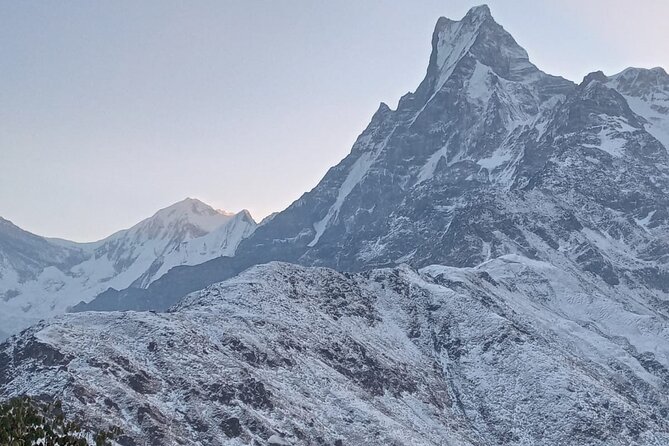
Mardi Himal Trek is interesting because it targets a less crowded feel than the famous Annapurna routes, while still bringing you face-to-face with Mardi Himal and Machhapuchhre. You start with gentle village paths, then climb through rhododendron forests until the trail turns into a proper high mountain route.
What I like most is how the trek mixes culture and scenery. The stop at Dhampus gives you a real taste of rural Gurung life before you shift into mountain mode, and the viewpoint moments at Deurali and Mardi Base Camp make the effort feel worth it.
One consideration: this is not a stroll. Day 4 climbs to Mardi Base Camp at 4500m, and Day 2 includes a stretch with no tea houses between Deurali and Forest Camp, so you need to carry what you’ll need.
Key things to know before you go
- Rhododendron forests that change fast into rocky high terrain
- Deurali and Badaldanda as built-in viewpoints
- Mardi Base Camp at 4500m as the high point
- A quieter route that still delivers Machhapuchhre views
- A Day 2 section without tea houses, so plan your supplies
- Guides who make the trek feel smooth and well organized, including Milan and Dilaram Poudel
Why this Mardi Himal route feels special from the start
This trek runs east of Annapurna Base Camp, and that placement matters. You get that classic Annapurna region vibe, but the route takes you through a different mix of terrain, from forest walking to ridge and base-camp scenery. The payoff is big, even though the itinerary is short enough to fit many schedules.
I also like that it does not act like you need to be an expert climber to enjoy it. The walking day structure builds step by step, starting with village trails and moving upward as the air thins. It is still serious altitude hiking, but the pacing has a logic.
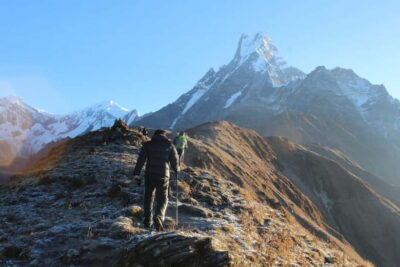
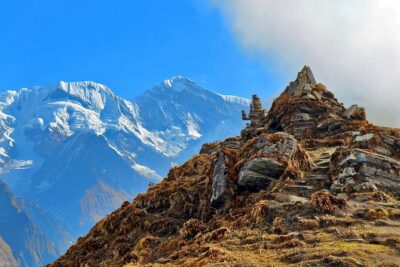
The official trek focus is Mardi Himal and the surrounding giants, including Machhapuchhre, Annapurna South, and Hiunchuli. You are not just walking for a summit photo. The route keeps aiming your attention at the mountain panorama, especially after you leave the lower forest zone.
More on the Mardi Himal ridge:
- Pokhara: 4-Day Mardi Himal Trek
★ 4.9 · 59 reviews - Private Mardi Himal Trek
★ 5.0 · 42 reviews - Mardi Himal Trek
★ 5.0 · 30 reviews
From Pokhara to the trail: how the 4N-5D schedule works
This is a 5 day plan in the common 4 nights style. You base yourself in Pokhara at the start, with pickup offered, and the trek begins from Banskot at about 1100m. That first day matters because you transition from city ease to slow mountain movement right away.
The itinerary is also designed around sleeping in teahouse-style accommodations. Those places usually mean simpler rooms and shared dining areas, and that is part of the charm. You are not spending all day with logistics. You hike, you eat, you sleep, you repeat.
At the end, the trek finishes back around Lumre and then you drive roughly an hour back to Pokhara. If you like finishing with something concrete instead of another night of hard travel, you will appreciate this.
Day 1: Banskot, Dhampus, Australian Camp, and Deurali viewpoints
Day 1 is your warm up that still gives you plenty to look at. You drive about half an hour along the Pokhara to Baglung highway, then start hiking at Banskot (1100m). After about an hour climbing, you reach Kalikasthan (1600m), where the views open up across villages and mountains.
From there the day becomes a sequence of short ups and downs. You descend to Hemjakot (1500m), then continue on to Dhampus (about 1170m), a small Gurung village. Dhampus is one of the most meaningful parts of the first day because you get rural culture right at the moment you are most likely to feel tired. It is a good mental reset before the higher climb begins.
After lunch in Dhampus, you ascend again to Australian Camp (2100m), then take the trail toward Deurali (2142m) via Pothana. Deurali is described as a viewpoint spot with a view down to Fewa Lake and out to surrounding mountains. That matters because it gives you a clear “okay, we’re really in this now” moment without waiting until the hardest day.
One small detail to plan for: there is a short admission-ticket-free stop noted early on the route. The itinerary does not spell out what it is, so just keep in mind your guide may stop for a quick visit or viewpoint moment around that area.
Day 2: sunrise, rhododendron forests, and the Day 2 no tea house stretch
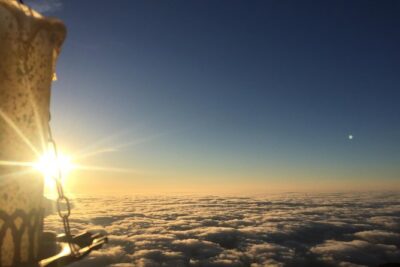
Day 2 starts early for sunrise and mountain views. Even if clouds show up, the morning push usually gives you calmer walking and more stable conditions for forest trails.
After breakfast, you walk along forest paths. The itinerary specifically calls out a section between Deurali and Forest Camp (2550m) where there are no tea houses. This is not a reason to cancel the trek, but it is a real planning point. You should make sure you have enough water and snacks before you enter the stretch, because there is no easy stop along the way.
As you go higher, the trail experience changes. You move through rhododendron forests filled with rhododendron flowers, then into grassland areas as the views expand toward the lower valleys. It is one of those days where you feel the trek getting louder in your senses, even though the route stays quiet.
Wildlife sightings are possible here, but you need to treat them as chances, not promises. The itinerary mentions rare animals you might see, including Himalayan Thar and spotted deer, plus an extremely unlikely snow leopard sighting. I recommend you enjoy the signs of wildlife rather than build your day around “seeing big cats.”
You reach Forest Camp for lunch, then continue about an hour to Rest Camp for the night. That “lunch first, then another short push” rhythm helps keep the day manageable.
More to compare around Pokhara
- ZipFlyer Nepal – The World’s Steepest Zip-line
★ 5.0 · 608 reviews - Bungee Pokhara by HighGround Adventures
★ 5.0 · 366 reviews - From Pokhara: Sarangkot Sunrise Himalayas Tour
★ 4.7 · 218 reviews - ATV Adventure Tour in Pokhara, Nepal
★ 5.0 · 194 reviews
Day 3: ridge walking toward Mardi views, Low Camp and Badaldanda
Day 3 is where the trek starts to feel more like a mountain route than a forest walk. Starting from Rest Camp, you gently ascend for about two hours to Low Camp (around 2990m), then climb another hour to Badaldanda.
Badaldanda is called out as a good viewpoint place. I like that because it gives you a natural break where you can stop, breathe, and take in the mountain panorama. It also helps you mentally separate the hike into parts, rather than one long grind.
From Badaldanda, you walk along the ridge of Mardi Himal. This is the part of the trek where you can look back and understand how the route is positioned. The itinerary notes views of Mardi Himal and Machhapuchhre along the way.
You continue through rhododendron forest for about an hour and a half, then enter the middle camp area as the tree line becomes less distinct and rhododendron bushes take over. This shift is common at higher elevations, and it is exactly the sort of “noticeable change” you want during a short trek. You feel how altitude and exposure shape the trail.
There is also a bird note. The itinerary says Daphne, Nepal’s national bird, is usually seen on the way to High camp. I would treat this as a fun bonus chance. If you spot it, great. If you do not, you still get the ridgeline mountain views that make the day worthwhile.
Day 4: the climb to Mardi Base Camp at 4500m (highest point)
Day 4 is the headline day. You wake early, then hike for about four hours to Mardi Base Camp at around 4500m, which is the highest point on this trek.
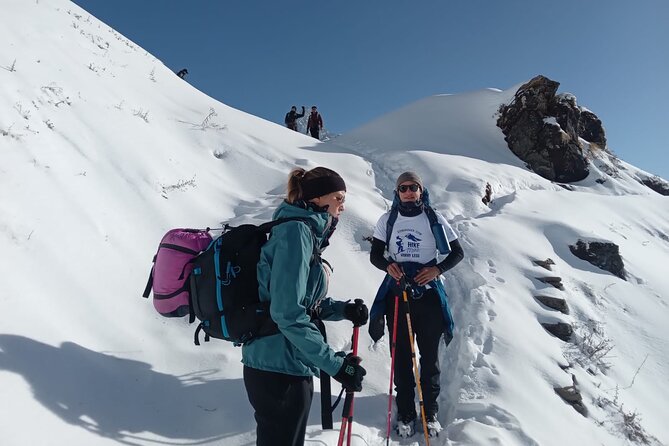
This day is described as more difficult than the previous ones. That makes sense for two reasons: you are climbing to higher altitude and the path becomes rocky and uneven in spots. You do not need to be a mountaineer, but you do need solid walking legs and good hiking rhythm. Think steady effort, not bursts.
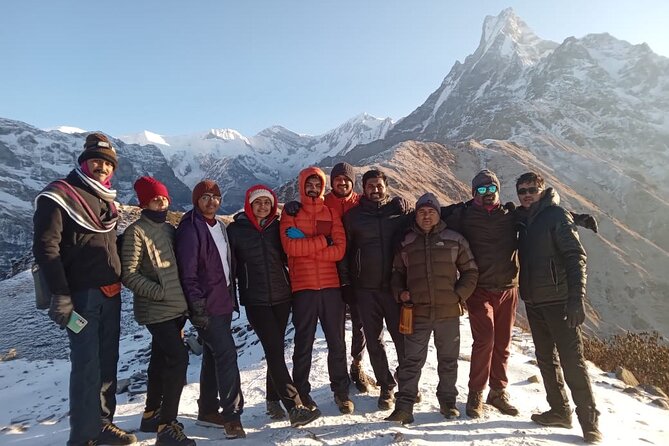
When you arrive at Mardi Base Camp, the itinerary promises snow-capped mountain views and natural vegetation. You also get wide views including Dhaulagiri, Machhapuchhre, and Mardi among others. Even with fatigue in your legs, this is the kind of moment where your brain goes quiet and just takes in what is around you.
After exploring, you retrace back to Badaldanda. I like retracing in this kind of short trek because it keeps navigation simpler. It also means the physical challenge is concentrated into the ascent and exploration period, instead of turning the whole day into new route guessing.
Day 5: steep forest descent, Kalimati ridge views, then Lumre to Pokhara
Day 5 starts with Badaldanda again, so you get at least one more sunrise-to-breakfast style viewpoint. After breakfast, you descend gradually to Low Camp, then the route changes character.
At Low Camp, the trail diverts east through forest with a steep descending section to Siding. This is a “watch your footing” moment. Steep forest descents are often harder on your knees than the initial climb felt, so take it slow.
Then you reach Kalimati at about 1700m. Kalimati is described as a small ridge with mountain views, farm lands, and valley views. It works as a final scenic course-correction. You are coming down from altitude, and this ridge moment helps you transition from mountain intensity back to everyday terrain.
You have lunch there, then walk down toward Lumre for about an hour before driving about an hour back to Pokhara. To finish, you share experiences over a farewell dinner. If you want a trek that ends with a clean emotional wrap-up, this style fits well.
Price and value: what $413.33 per person really covers
At $413.33 per person for about five days, the value depends on what you would otherwise pay separately. Here, your cost is doing real work.
Included items that strongly affect value:
- Trek permits paperwork (ACAP and TIMS) plus any related fees
- An experienced, English-speaking, government-licensed trekking guide
- Teahouse accommodation during the trek
- Meals: 4 breakfasts, 5 lunches, and 4 dinners
- Medical kit carried by your guide
- Transportations tied to the trek start and finish
- A completion certificate and a souvenir t-shirt
Also, it is not presented as a bare-bones hike. There is staff cost coverage too, including salary, insurance, equipment, food, and accommodation for the support team.
What is not included, and why it matters:
- Travel and rescue insurance is on you
- Tips for guide(s) and driver(s) are not included
- Personal expenses like water, laundry, or battery recharges are not included
If you are comparing offers, the smartest move is to compare “meals plus teahouses plus permits plus guide” against cheaper options that quietly remove those pieces. Here, the structure is built to keep you fed and moving without you having to manage daily logistics.
Guides, organization, and the human part that makes it feel easy
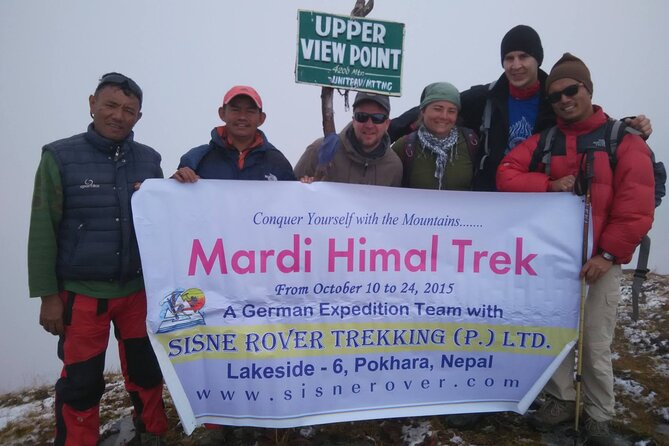
The best compliments in the reviews center on responsiveness and solid guiding. Dambar, connected with the trip setup, is repeatedly described as extremely responsive during the booking process and good at answering questions before the trek begins.
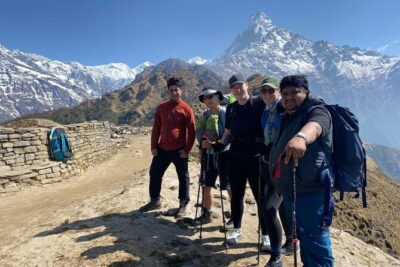
On the trail, the names that show up again and again as standouts include Milan, Dilaram Poudel, Ram, Krishna, and Prince Dila Ram. People highlight strong support, good company, and the way guides handle the details so you can focus on walking and scenery. One review mentions a guide who was strong, patient, and knowledgeable in the mountains, and another calls out leadership and a friendly, steady approach.
For you, the practical takeaway is simple. This trek works best when your guide helps with pacing, trail confidence, and day-to-day decision-making, like when to take breaks and how to handle altitude changes. When the group feels supported, you notice it most on the harder parts, especially the rocky Day 4.
Fitness, altitude reality, and how to pace the hard day
The itinerary frames the trek as requiring moderate physical fitness. That is realistic, but you should still train. You do not need gym miracles, but you do need regular walking time before you arrive.
Also, altitude is part of the deal here. You start around 1100m, climb through camps in the 2000m to 3000m range, and reach 4500m at Mardi Base Camp. Even with short distances, the air gets thinner, and your breathing changes.
Your best strategy for altitude is to pace early. Keep your effort steady. Use the natural breaks at viewpoint spots like Deurali and Badaldanda. And on Day 4, accept that the rocky uneven section will take more time than you think. Going too fast early usually means you pay for it at base camp.
What to expect with teahouses, meals, and the no-tea-house segment
Teahouse accommodation is included during the trek. That usually means you are sleeping in simple rooms and eating in a shared dining area. You should expect modest conditions, not hotel comfort.
Meals are also included, which helps a lot at higher elevations when appetite and energy can swing. You get a planned set of breakfasts, lunches, and dinners, and that reduces decision fatigue.
The one exception you should respect is the Day 2 segment without tea houses between Deurali and Forest Camp. That is the day to be extra sure you have what you need in terms of snacks and water before that stretch. Your guide will manage it, but you are still the one who needs to show up prepared.
Who this trek suits best (and who should reconsider)
This trek is a good fit if you want:
- A short 5-day trek with a high-mountain goal
- Forest-to-ridge-to-base-camp scenery
- Built-in viewpoint stops like Deurali and Badaldanda
- Teahouses and included meals so you can focus on hiking
It may not be ideal if:
- You struggle with rocky uneven walking at altitude
- You do not like steep forest descents, since Day 5 includes a steep drop to Siding
- You want lots of frequent stops for rest or snacks, because Day 2 includes a no tea house stretch
If your group includes first-time hikers, the moderate fitness framing and guide-led support make it manageable, as long as everyone understands the altitude hike is the main challenge.
Should you book the Mardi Himal Trek 4N-5D with Sisne Rover Trekking?
I would book this trek if you want a focused Himalayan experience without spending weeks on logistics. The best reasons to choose it are the route design, the mountain views tied to multiple viewpoint days, and the fact that permits, guide, teahouses, and most meals are covered.
I would think twice if you have zero tolerance for altitude effort or you cannot handle a rocky Day 4 and a steep Day 5 descent. Also, if you dislike carrying your own supplies through any stretch, you should plan carefully for the Day 2 no tea house segment.
If you are the kind of traveler who enjoys quiet walking, rhododendron forest breaks, and the long, satisfying payoff at a high point, this itinerary makes a lot of sense. And with guides like Milan, Dilaram Poudel, Krishna, Ram, and Prince Dila Ram highlighted by name in strong reviews, you are not just buying a route. You are buying day-by-day support that helps the trek feel doable.
FAQ
Where does the trek start and how do I get to the trail?
You meet at Sisne Rover Trekking Pvt. Ltd. in Pokhara, and pickup is offered. The trek itself starts at Banskot (1100m).
How long is the Mardi Himal Trek?
It is listed as about 5 days (4 nights and 5 days).
What is the highest altitude on this trek?
The highest point is Mardi Base Camp at about 4500m.
Are teahouse accommodations included?
Yes. Teahouse accommodation during the trek is included.
What meals are included?
Breakfast is included for 4 days, lunch for 5 days, and dinner for 4 days.
Do I need trekking permits in advance?
The tour includes necessary permits and paperwork, including ACAP and TIMS.
Is there transportation during the trek?
Transportations related to the trip are included, and after the trek you drive back to Pokhara.
Are there any stretches without tea houses?
Yes. Between Deurali and Forest Camp (2550m), the path does not have tea houses.
Is this a private tour?
Yes. It is a private activity, and only your group will participate.
What is not included in the price?
Personal expenses are not included, along with travel and rescue insurance, tips for guides and staff, bar bills, and any transport not listed as included.
Latest Pokhara write-ups
- Sunrise View from Sarangkot★ 5.0 · 3 reviews
- Beautiful Sarankot Sunrise with Full Day Sightseeing in Pokhara★ 4.5 · 3 reviews
- Sarangkot Sunrise Tour in Private Car★ 5.0 · 3 reviews
- Pumdikot Mahadev Status and Peace Stupa Hiking Private Tour★ 4.5 · 3 reviews
- Pokhara: Dhampus Easy Trek for Families with YoungKids 2 Day Tour★ 5.0 · 3 reviews
- Pokhara: Private Car Drive Tour to World Peace Stupa★ 5.0 · 3 reviews
- 5-Day Private Farming Experience in Nayapul with Accommodation★ 5.0 · 3 reviews
- Transfer to Lower Mustang (Jomsom)★ 5.0 · 3 reviews
Mardi Himal Trek, compared.
Mardi Himal Trek – 8 Days | Hidden Gem of the Annapurnas
Read our review →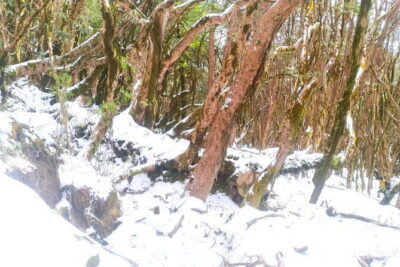
Browse the lists this tour appears in