
Reviewed · CITY TOURS
Kathmandu City Tour
Kathmandu can feel like a living museum, and this tour focuses your day on the biggest UNESCO World Heritage sites. You will go up to the Swayambhunath hilltop, watch prayer at Boudhanath, then walk through royal palace squares in Kathmandu and Patan.
I really like the pacing. You get about 1 hour 30 minutes at each main stop, which is enough time to see the highlights without feeling like you are sprinting. I also like the human touch behind the scenes, including support from their team, and a guide named Ramesh who has helped groups handle changes smoothly.
One thing to plan for: entrance fees are not included, and lunch is also not included. So budget a bit extra on top of the $100 group price.
Key highlights you will actually care about
- UNESCO hits in one day: Swayambhunath, Boudhanath, and Durbar Squares in the Kathmandu Valley.
- Swayambhunath is hilltop chaos (in a good way): monkeys plus Buddhist and Hindu iconography.
- Boudhanath feels like a real ritual space: join Tibetan pilgrims on morning and evening koras.
- Kathmandu Durbar Square includes Hanuman Dhoka: the name comes from a Hanuman statue at the palace entrance.
- Patan adds the art angle: you pass the royal palace and temples, plus time around the Patan Museum.
- Small-group care: the experience lists a maximum of 4 travelers, while pricing is quoted per group.
Price and logistics: what $100 per group really buys
This is priced at $100 per group for up to 10 people, and the experience also states a maximum of 4 travelers. In plain terms, you are paying for a guided, vehicle-based half-day that strings together the key UNESCO sights without you having to figure out routing and timing on your own.
What you get for that money is practical, not fancy: an air-conditioned vehicle and bottled water, plus pickup is offered and you receive a mobile ticket. That matters in Kathmandu, where heat, traffic, and long walks can stack up quickly. Having AC transport between temple zones buys you real recovery time.
What is not included is equally important for value. Entrance tickets are not included, and lunch is not included. So even though the tour price looks simple, your total day cost will be higher once you add admissions and food.
A final logistics note from the way this company seems to run: people describe the service as hassle free and organized, with strong support around timing and needs. One guide, Ramesh, is specifically mentioned as excellent, especially when travel plans got complicated during disruptions.
More City Tours in Kathmandu
- Private Kathmandu Sightseeing Tour | UNESCO World Heritage sites
★ 5.0 · 756 reviews - Kathmandu: Private City Guided Tour
★ 4.9 · 174 reviews - Kathmandu Private Sightseeing Tour | UNESCO World Heritage Sites
★ 5.0 · 109 reviews
The 9:00 am start and how to use the day well
The tour start time is 9:00 am, and the day runs about 7 hours total. The schedule gives you roughly 1 hour 30 minutes at each stop, which is a solid rhythm for sightseeing in Kathmandu.
Here is the smart way to think about it: you are doing four major sites in one day, and each one has its own atmosphere. If you show up frazzled, you will rush and miss details. If you show up rested, you will notice the little things, like the all-seeing Buddha eyes at Boudhanath or the palace courtyards in the Durbar squares.
Plan for walking. Temple sites are not museum floors. They have steps, uneven ground, and tight areas. This is not a problem if you come with shoes you trust and a calm pace.
Also, bring a little flexibility. The tour requires good weather, and if it has to be canceled due to poor conditions, you are offered another date or a full refund. That is worth respecting, because these are outdoor historic sites where visibility and comfort matter.
Stop 1: Swayambhunath, the monkey temple you will remember
Swayambhunath is one of Kathmandu’s defining experiences. It sits on a lofty hilltop, and the climb sets the tone for what comes next: you reach a UNESCO World Heritage site that mixes Buddhist and Hindu iconography in one complex.
The headline here is the monkeys. You will see them around the temple approaches, and the area is described as mobbed by monkeys. That means your photos will be lively, but it also means you should treat the area like an animal-rich space. Keep your hands to yourself near food, and watch where you set anything down.
Why this stop is worth your time: it is not just a temple. From up there, you get a different feel for the city. It is also a good place to slow down because once you reach the main viewing areas, you can take in details without needing to keep moving fast.
What could be annoying: the hilltop nature of the site can be tiring. You might feel it in the legs after the climb, especially if you are not used to walking stairs. Build a little margin and let your guide set the flow.
Important practical point: admission is not included for Swayambhunath, so you will want to budget for the entry ticket.
Stop 2: Boudhanath stupa and the rhythm of the koras
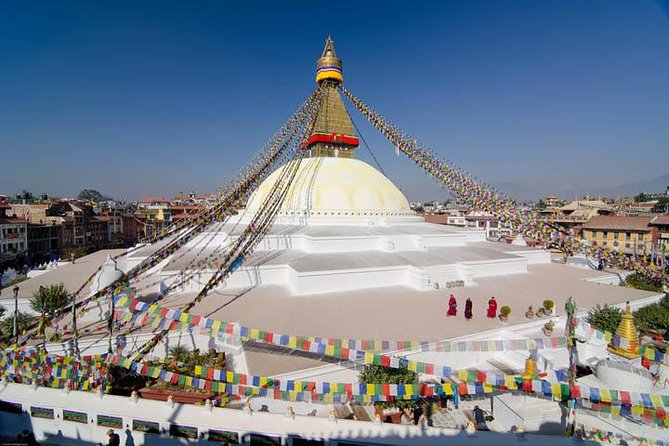
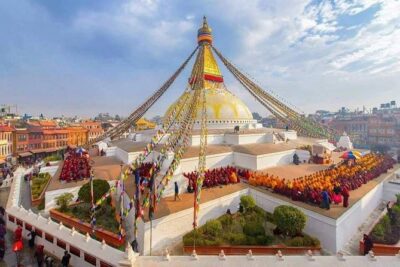
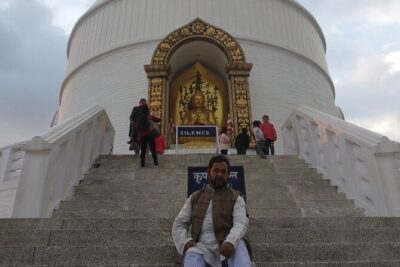
Boudhanath is where Kathmandu shifts from hilltop views to deep ritual atmosphere. The stupa is described as a standout in Nepal for grace and purity of line, with a whitewashed dome and a gilded tower that includes the painted all-seeing eyes of the Buddha.
The history angle is strong, too. The first stupa at Boudhanath was built sometime after AD 600, tied to Tibetan king Songtsen Gampo, who converted to Buddhism. Even if you do not chase dates, knowing that lineage helps you understand why the place feels so connected to Tibetan Buddhism.
This stop also comes with a built-in performance of culture: join Tibetan pilgrims on their morning and evening koras, meaning circumambulations around the stupa. That is one of the easiest ways to feel how locals use a World Heritage site. You are not just looking, you are seeing the daily rhythm at work.
How to make it go smoothly: stay aware of where the crowd moves, and give the line of pilgrims room. If you stop in the wrong spot for a photo, you can block traffic without meaning to.
What could be a drawback: depending on the time of day and crowd levels, the area can feel packed. The upside is the energy. The downside is that you may need to be patient while moving to the angle you want.
And again, a practical note: entrance fees are not included, so the ticket for Boudhanath is on you, not covered in the tour price.
A different sort of day out of Kathmandu:
- Everest Base Camp Trek – 14 Days
★ 5.0 · 1,499 reviews - Everest Base Camp Trek
★ 5.0 · 842 reviews - Kathmandu: 7 UNESCO Sites with Lunch
★ 4.8 · 744 reviews - Everest Base Camp Helicopter Tour landing at Everest View Hotel
★ 5.0 · 668 reviews
Stop 3: Kathmandu Durbar Square and Hanuman Dhoka Palace
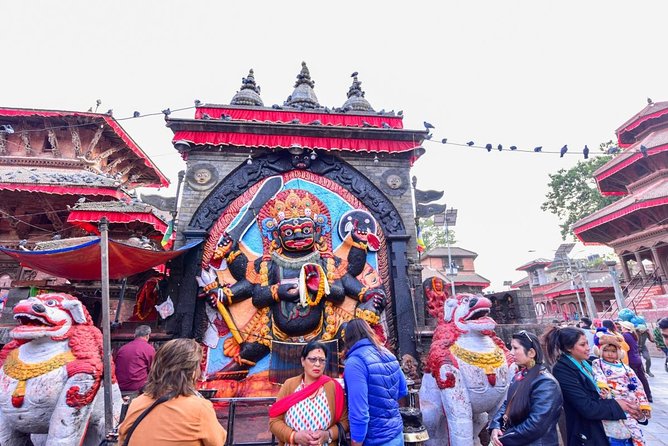
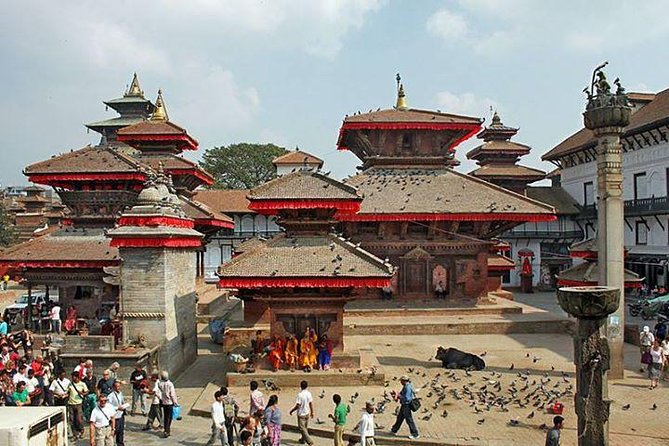
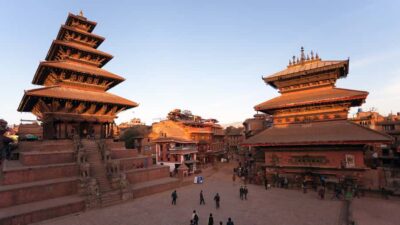
Now you switch from stupa ritual to royal palace history. Kathmandu Durbar Square, also known as Hanuman Dhoka Durbar Square, is the plaza in front of the old royal palace of the then Kathmandu Kingdom.
Here is what makes it more than a random square full of temples. The Durbar square holds palaces of the Malla and Shah Kings, and the space is arranged around quadrangles with courtyards and temples. In other words, this is a complex, not a single monument.
The name matters too. It is called Hanuman Dhoka because of a statue of Hanuman, the monkey devotee of Lord Ram, at the entrance of the palace. If you look for it, you will get the meaning fast.
One of the big reasons I like Durbar squares: they show you how power expressed itself in architecture. You see how rulers turned religion, ceremony, and governance into one physical layout. Even if you know little about the dynasties, the courtyards and temple groupings help the story click.
Possible drawback: Durbar squares are easy to feel overwhelmed by. You see lots of stonework, niches, and small shrines. This is where pacing matters. With the guided format giving you about 90 minutes, you can pick what to focus on instead of spinning in circles on your own.
Entrance fees for this stop are not included, so plan on that extra cost.
Stop 4: Patan Durbar Square, museum time, and Newari artistry
Most Kathmandu city tours stop at just one Durbar Square. This one also includes Patan Durbar Square, which is a smart move because Patan feels different in character and craft.
Patan is often called the City of Art, and the tour route reflects that. You go through the heart of the UNESCO World Heritage Site and explore the royal palace, temples, and surrounding neighborhoods. You also have time connected to the Patan Museum, which is where rare works of art are showcased.
The Newari angle is important. The description ties the art quality to the Newari people and their reputation for artistic ability. Even without a deep art lecture, the temples and palace structures give you a clear sense that this region specialized in fine religious and architectural detail.
What makes this stop enjoyable rather than just a repeat: Patan can feel more arts-and-crafts oriented than the Kathmandu palace zone. You will likely find yourself noticing different motifs and temple layouts.
A practical caution: museum time plus palace-courtyard time can mean you are in and out of covered spaces and open courtyards. Dress for comfort, and pace yourself.
Just like the others, admission tickets are not included, so you will want to bring funds for entry where required.
Comfort, vehicle time, and the small details that reduce stress
This tour includes air-conditioned vehicle transport and bottled water, which sounds basic until you experience Kathmandu in a full day of sightseeing. AC ride breaks matter when you are going from temple to stupa to palace squares, and back again.
Another stress saver is the service approach. In feedback, people highlight familiar, friendly support and good communication. There is even mention of staff assisting from airport to airport in some cases, plus seniors from the office calling and checking in if anything is needed. That kind of follow-through does not change the monuments, but it changes how safe and calm you feel while navigating a new city.
The tour also uses a mobile ticket, which can simplify check-in and reduce paper shuffling.
One more small point: service animals are allowed, which can matter for some visitors.
If you are the type who likes your days planned and predictable, this setup fits. If you want total free wandering time, you might find 1 hour 30 minutes at each stop a little structured. Still, it is a good balance for seeing four major sites in one go.
Who should book this Kathmandu UNESCO city tour
Book it if you want a guided day that hits the core UNESCO landmarks without turning your trip into a logistics project. It fits well if you:
- want a single, organized route through Swayambhunath, Boudhanath, Kathmandu Durbar Square, and Patan Durbar Square
- value support from a guide, including real help like advice and troubleshooting
- prefer small-group energy with a stated maximum of 4 travelers
It might not be the best fit if you:
- hate walking up to hilltop sites like Swayambhunath
- want the freedom to linger for hours inside each courtyard with no time pressure
- want lunch included in the package price
Should you book it? My take
If you are trying to make the most of limited time in Kathmandu, this tour is a strong way to do it. You are paying $100 per group, and the practical inclusions, AC transport and bottled water, plus guided movement between UNESCO sites, add up fast. The biggest “cost surprise” is that entrance fees and lunch are not included, so treat the tour price as a base, not a final total.
The other reason I would lean toward booking is the human support. The guide experience is praised, including Ramesh, and people describe the service as organized, helpful, and calm even when plans change. That is exactly what you want in a day built around major sacred places.
If good weather is forecast and you are willing to budget for admissions, you will likely come away feeling you actually saw Kathmandu’s key temple and palace landmarks, not just drove past them.
FAQ
How long is the Kathmandu City Tour?
The tour duration is about 7 hours.
What time does the tour start?
The start time is 9:00 am.
Is pickup included?
Pickup is offered.
What is included in the tour price?
The tour includes an air-conditioned vehicle and bottled water, and you receive a mobile ticket.
Are entrance fees included?
No, entrance fees are not included.
Is lunch included?
No, lunch is not included.
Which UNESCO World Heritage sites are visited?
You visit Swayambhunath, Boudhanath, Kathmandu Durbar Square (Hanuman Dhoka Durbar Square), and Patan Durbar Square.
What is the group size?
The experience lists a maximum of 4 travelers.
What happens if the weather is poor?
This experience requires good weather. If it is canceled due to poor weather, you will be offered a different date or a full refund.
What is the cancellation policy?
You can cancel for free up to 24 hours in advance for a full refund. Changes within 24 hours of the start time are not accepted, and cancellations inside 24 hours are not refunded.
Latest Kathmandu write-ups
- Langtang Valley Trek★ 5.0 · 3 reviews
- Khopra Danda Trek★ 5.0 · 3 reviews
- Langtang Valley Trek from Kathmandu★ 5.0 · 3 reviews
- 5 night / 6 days Kathmandu Nagarkot Chitwan Pokhara tour★ 5.0 · 3 reviews
- Nepal Highlights Tour: 5 Nights 6 Days Kathmandu & Pokhara Tour★ 5.0 · 3 reviews
- Kathmandu Valley Private Day Tour★ 5.0 · 3 reviews
- Conquer the Himalayas: The Ultimate 16-Day Annapurna Circuit Trek★ 3.5 · 3 reviews
- Kathmandu Heritage Day Tour★ 5.0 · 3 reviews
City Tours, compared.
Private Kathmandu Sightseeing Tour | UNESCO World Heritage sites
Read our review →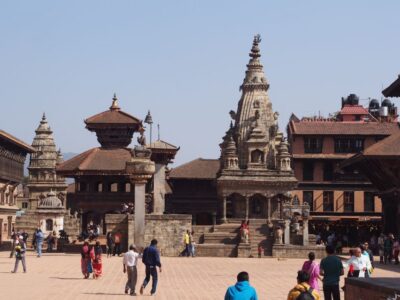
Kathmandu Private Sightseeing Tour | UNESCO World Heritage Sites
Read our review →
Browse the lists this tour appears in