
Reviewed · FULL-DAY TOURS IN KATHMANDU
Kathmandu Full Day Tour
Kathmandu is a city where religions share the same streets, and this full-day circuit is a smart way to understand why fast. You move through major UNESCO-listed sites in one loop, with hotel pickup and drop-off so you do not waste your first hours hunting a meeting point, and you get clear explanations from a local guide that makes Hinduism and Tibetan Buddhism feel connected instead of random.
I especially like the tight structure for first-timers, because the day is planned around the big names: Swayambhunath, Kathmandu Durbar Square, Pashupatinath, and Bouddhanath. The one thing to plan for is cost creep, since entrance fees are not included and lunch is on you, plus some days can involve more walking than you expect if transport gets interrupted.
If you want an efficient orientation to Kathmandu, this is a solid pick. I have seen guide names like Birodh Burlakoti pop up for good reason, with praise for easy English and the way he turns site viewing into real understanding, not just ticking boxes.
Key things to know before you go
- One day, four headline UNESCO sites, covering both Hindu and Buddhist landmarks
- Hotel pickup and drop-off, which saves time and stress in busy old Kathmandu
- Small-group feel with a max of 30 travelers, usually better for questions and pacing
- Transport plus a local guide, so you spend less time figuring things out
- Admission fees are extra, with an approximate 2600 NPR per person to budget for
- Earthquake damage may be visible, since some sites were affected by the 2015 earthquakes
Why this Kathmandu UNESCO circuit works on a time crunch
This tour is built for the traveler who has limited time but still wants a real first look at Kathmandu. The plan is about balance: you start with a Tibetan Buddhist stupa, then shift to the old royal core at Kathmandu Durbar Square, then move to one of the most important Hindu sites for Lord Shiva, and end at Bouddhanath, the large Buddhist stupa that anchors the valley’s spiritual landscape.
Duration is about 6 hours, which is long enough to feel like you did something meaningful, but short enough that you are not stuck all day. That matters in Kathmandu, where heat, traffic, and crowds can add up fast. For an intro day, this kind of routing helps you build a mental map before you branch out on your own.
More Full-Day Tours in Kathmandu
- Kathmandu: Full Day 7 UNESCO Tour with Lunch – Private/Group
★ 5.0 · 415 reviews - Kathmandu: Full Day Top 4 UNESCO Tour with Lunch – Private/Group
★ 5.0 · 269 reviews - Kathmandu: Full-Day 7 UNESCO Tour with Lunch – Private/Group
★ 4.9 · 247 reviews
Hotel transfers and private transportation: the comfort factor
Logistics are a big part of why this tour gets booked. Pickup from your hotel and drop back at the end of the day is included, and you are not relying on guessing buses or finding taxis at each stop. The tour also includes private transportation, and it is described as small-group departure.
You will usually be handed a simple plan: where to meet, when to go, and how to get from place to place. That is a quiet win for jet lag or a first arrival day. The tour also uses a mobile ticket, which is convenient if you prefer keeping everything on your phone.
One practical note: at least one past traveler reported a transport issue midway that forced extra walking on dusty roads under strong sun. That is not the normal ideal, but it is a reminder to pack for comfort. Wear shoes you can walk in, bring water, and use sun protection even if the day feels “guided and scheduled.”
Stop 1: Swayambhunath Temple, your Tibetan Buddhism start point
The day begins at Swayambhunath Temple. It is described as a Tibetan Buddhist stupa, and the stop is about 1 hour with admission tickets not included.
This first stop matters because it sets the tone for the rest of the day. You shift from one religious tradition to another without needing to “translate” what you are seeing on your own. A good guide can explain why stupa culture and temple culture look different but still serve a similar spiritual purpose.
In practical terms, use this hour to get oriented in Kathmandu’s temple rhythm. You do not need to rush. If you want the most out of it, ask your guide what to focus on in that site, and then take your time looking around before you move on.
Stop 2: Kathmandu Durbar Square and Hanuman Dhoka, where history feels close
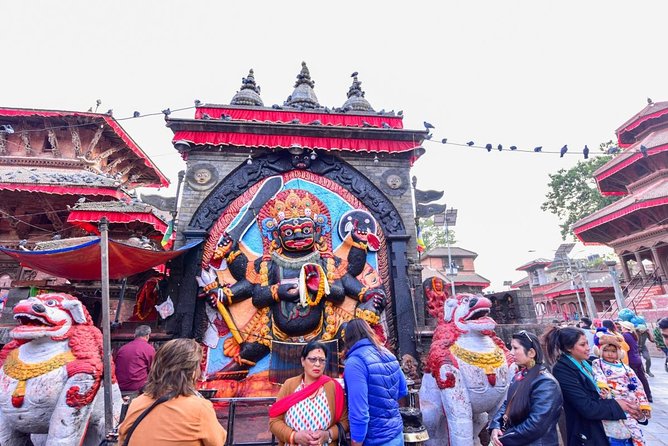
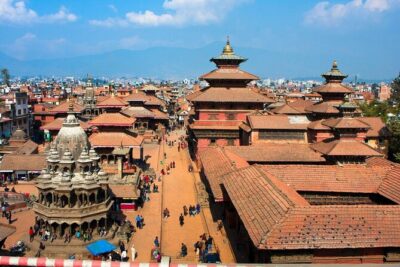
Next up is Kathmandu Durbar Square, also known as Hanuman Dhoka Square or Basantapur. This is another UNESCO World Heritage Site, and the visit is about 1 hour, with admission tickets not included.
What makes this stop worth your time is the setting. The square is in the heart of old Kathmandu city around Basantapur, tied to the royal palace area. You are looking at a group of palaces, courtyards, and temples, not just a single structure. This is the part of Kathmandu where the city’s power and faith visibly overlap.
A helpful way to use your hour: keep your questions simple. Ask how the palace zone relates to the religious sites you will see next. If you have a guide with strong English, this is often where their explanations make the most immediate sense, because you can point to what you see and connect it to what they are saying.
More to compare around Kathmandu
- Everest Base Camp Trek – 14 Days
★ 5.0 · 1,499 reviews - Everest Base Camp Trek
★ 5.0 · 842 reviews - Private Kathmandu Sightseeing Tour | UNESCO World Heritage sites
★ 5.0 · 756 reviews - Kathmandu: 7 UNESCO Sites with Lunch
★ 4.8 · 744 reviews
Stop 3: Bouddhanath Stupa, the 36-meter highlight in the east
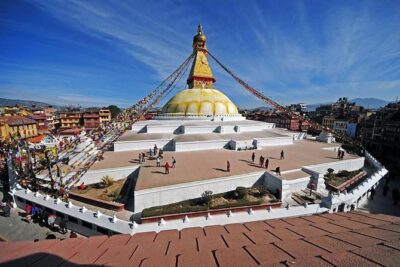
You then head to Bouddhanath Stupa, about 8 km east of downtown Kathmandu. The stupa is described as a standout major site, with a height of 36 meters, and it is noted as one of the biggest stupas in the Kathmandu Valley. The stop is about 1 hour, with admission tickets not included.
If you have only seen a few Buddhist sites before, this one helps you get a sense of scale. The height and prominence are the point. You also finish the religious arc by ending with a stupa that many people recognize as a major landmark, even if they are not deep into Buddhist study.
In an organized tour day, this is your “slow down” stop. It is easy to take too many photos and lose the context. Instead, take a moment to understand what makes this stupa important to the valley, then revisit your favorite angle for photos once the meaning clicks.
Stop 4: Pashupatinath Temple, Shiva’s major Hindu pilgrimage site
The final major stop is Pashupatinath Temple, devoted to Lord Shiva. This site is described as one of the four most vital religious sites in Asia for Shiva devotees. The tour notes it was built in the fifth century, and later redesigned by Malla rulers. Again, the visit is about 1 hour, and admission tickets are not included.
This is your big Hindu anchor, and it completes the day’s push-pull between traditions. If your guide’s English is strong, this is where you often hear the most “why it matters” explanations. One past traveler specifically praised guide English so much that the stories behind what they saw felt alive, not memorized.
A practical expectation: religious sites can feel intense, with lots going on around you. Use your hour to listen closely and look for the most meaningful parts of the complex your guide points out. If you are unsure what you are looking at, ask. This is a tour where questions actually pay off.
Price and logistics: what $70 really buys you
The tour price is $70 per person, and it is commonly booked about 8 days in advance. For that, you get pickup and drop-off, a local tourist guide, a small-group departure, and private transportation.
The trade-off is that you should budget for entrance fees. Entrance fees to visit UNESCO sites are listed as approximately 2600 NPR per person, and they are not included. Lunch is also not included.
So the real value question is this: are you saving enough time and effort to justify paying for a guided day? For many first-time visitors, yes. You are seeing four headline sites in one coordinated run, and you have a guide translating meaning as you go. If you were trying to DIY the same plan, you would spend time figuring out routing, guides, and timing, and you might miss context that a good local guide can explain in minutes.
What the best guides do for you in Kathmandu
The reviews make one thing clear: the guide can turn this from a bus tour into a learning day. Several high ratings praised deep understanding and excellent English. Birodh Burlakoti comes up by name, including praise for easygoing style and the way he explains history and significance in a way that helps the sites click.
One traveler also mentioned that the guide took initiative beyond the big stops, helping them with extra insights in Thamel, which is useful if you want to know where to go next after the tour ends. Another review mentions the guide being a good photographer, which suggests you might not just get explanations, you might also get help framing photos at the right moments.
There are a couple of watch-outs too. One review described a guide pace that made it hard for even young or fit travelers to keep up. Another mentioned that if the guide’s English pronunciation was not clear, it could be easy to miss names or details and get confused. Your fix is simple: ask questions when you do not understand, and tell the guide if you need a slower pace. A good guide will adjust.
Comfort tips that match what can happen on the day
Even with hotel transfers and private transport, Kathmandu days can be bumpy. One past traveler reported a vehicle breaking down halfway, which led to a dusty, traffic-heavy walk in the sun for more than 30 minutes. That is not something you should expect, but it is enough of a possibility that you should pack like it might happen.
Here is what I recommend for comfort, with the day’s reality in mind:
- Bring water and a snack option, since lunch is not included
- Wear sun protection and comfortable walking shoes
- Keep your phone charged for mobile tickets and navigation after the tour
- Be ready to walk between viewpoints and temple areas, since sites are not always “parked at” by default
If heat is a problem for you, plan your rest of the day around it too. This tour is about religious landmarks, but your body will feel the day as much as your mind does.
Earthquake damage: why you might see changes on some structures
One important note is that there has been significant damage to some of the sites visited on this tour due to the earthquakes in April and May 2015.
This does not mean you should avoid the tour. It means you should expect to see evidence of restoration, rebuilding, or differences from what you might imagine from old photos. If you are the kind of traveler who likes context, this is where your guide can be especially useful, because they can point out what you are seeing now and explain why it looks the way it does today.
So who should book this tour?
This is a strong fit if you:
- Are in Kathmandu for the first time and want a fast intro to the city’s major religious landmarks
- Want a structured route that includes hotel pickup and drop-off
- Like guided explanations that connect Hindu and Tibetan Buddhist sites
- Prefer a small-group day with private transportation rather than DIY logistics
It may not be the best fit if you:
- Want fully guided time at just one site, instead of moving every stop in about 1 hour
- Do not want to pay additional entrance fees or handle lunch separately
- Need a very slow pace, since one review mentioned the walking pace could be hard for some travelers
Should you book this Kathmandu Full Day Tour?
I would book it if you are after an efficient, high-impact intro day that saves you from the “where do I start” confusion of Kathmandu. The combination of major UNESCO stops, hotel transfers, and a local guide who can explain what you are seeing is the core value, and that lines up with the highest ratings.
Before you go, do two things: budget for the UNESCO entrance fees (about 2600 NPR per person) and plan for some walking and sun, just in case transport runs into trouble. If that works for you, this tour is an excellent way to get your bearings fast and leave Kathmandu with a better sense of the city’s spiritual map.
FAQ
How long is the Kathmandu Full Day Tour?
It runs for about 6 hours.
What sites are included in the tour?
The tour visits Swayambhunath Temple, Kathmandu Durbar Square, Bouddhanath Stupa, and Pashupatinath Temple.
Are UNESCO entrance fees included in the price?
No. Entrance fees are not included and are listed as approximately 2600 NPR per person.
Is lunch included?
No, lunch is not included.
Do I get hotel pickup and drop-off?
Yes. Pickup from your hotel and drop back to your hotel after the tour are included.
Is this a private tour or a group tour?
It is a small group departure with private transportation. The tour also states a maximum of 30 travelers.
What is the tour price?
The price is $70.00 per person.
What ticket format do I receive?
The tour includes a mobile ticket.
What time does the tour operate?
The opening hours are Monday through Sunday from 9:15 AM to 5:15 PM.
Is there a cancellation window?
Free cancellation is available. You can cancel up to 24 hours in advance for a full refund.
Latest Kathmandu write-ups
- Langtang Valley Trek★ 5.0 · 3 reviews
- Khopra Danda Trek★ 5.0 · 3 reviews
- Langtang Valley Trek from Kathmandu★ 5.0 · 3 reviews
- 5 night / 6 days Kathmandu Nagarkot Chitwan Pokhara tour★ 5.0 · 3 reviews
- Nepal Highlights Tour: 5 Nights 6 Days Kathmandu & Pokhara Tour★ 5.0 · 3 reviews
- Kathmandu Valley Private Day Tour★ 5.0 · 3 reviews
- Conquer the Himalayas: The Ultimate 16-Day Annapurna Circuit Trek★ 3.5 · 3 reviews
- Kathmandu Heritage Day Tour★ 5.0 · 3 reviews
Full-Day Tours in Kathmandu, compared.
Full Day Private Tour of Kathmandu – UNESCO World Heritage Sites
Read our review →
Full Day Kathmandu City Sightseeing Tour of UNESCO Heritage Sites
Read our review →Browse the lists this tour appears in